Posts

Showing posts with the label science

Getting my beliefs challenged II

I am going down yet another rabbit hole. It diverges from the one I was falling down about a year and a half ago . At least somewhat. All roads lead to Rome, but not all are main highways and will get you to your final destination; they do move you forward, though. My new rabbit hole is all about how, if I forgive everyone and everything, we will all cease to exist and happily so. Some background: I accidentally learned of ho'oponopono . In looking for more information, I ended up reading Joe Vitale's book "Zero Limits" (and I really liked it). All my decades of swearing to affirmations to accomplish something got set aside while I instead practiced on chanting "I love you" inside my head. I have since gone back to using my usual morning affirmation since that seems to be such a good set-up for me and my day. 1 However, the ho'oponopono method makes perfect sense to me and it is far simpler (and more foolproof) than affirmations. Affirmations req...

Boobies: To squeeze or not to squeeze

Image
Yes, this post will be about boobies. Also known as tits. Mugs. Jugs. Bazongas. Melons. Breasts. Breasts and the big squeeze. Also known as getting a mammogram. In Norway, all woman are automatically offered bi-annual mammography examinations between the ages 50 and 69. Just before Easter this year, I got the letter informing me of my first appointment, accompanied by a questionnaire and a brochure, all delicately done in pleasant shades of pale green (now long recycled). Every time I see the picture of a well-endowed woman (they always seem to have pendulous, D-cup boobies), topless, standing next to a large piece of machinery, with one breast flattened between two plates of glass, I cringe. I cringe mightily. Breasts are sensitive and don’t like rough handling, and it hurts like hell to get them squeezed. So I’ve read about breast cancer and mammography and I’ve also read about alternative technologies of spotting growths in mammaries, like shining a light through like wh...

The grace of a hawk

Image
A commenter to this movie on YouTube wished hawks were like dogs so you could pet them when they do stuff like this. That's what I was thinking! Birds of prey are both so beautiful and so graceful. Just how graceful is shown in this BBC video. I'm also fascinated by how feathers move in slow-motion.

Getting my beliefs challenged

I own the extended DVD set of "What the #$*! Do We (K)now!?" , also known as "Down the Rabbit Hole". I can't remember now how my browsing the internet today started, but I ended up learning a lot about the science in "What the Bleep": It's terribly inaccurate. There are other inaccuracies or downright errors, but for the most part quantum mechanics only work on quantum levels, not at sizes like a basketball or a universe or even a mere atom. And that spoils all New Age claims that it is quantum physics that explain the Law of Attraction or any other woo-woo belief, like spontaneous healing, psychic phenomenon or near-death experiences. Dang. I was so hoping science could explain these things by now. My surfing has brought me to The Committee for Skeptical Inquiry . There I have found good writing, and proper skepticism. Not the finger-pointing pooh-poohing of beliefs, but rather a behind-the-scenes look at some claims and what's factually ...

The known universe

This brilliant film is making the rounds. I found mine over at A Pacific View . Here's the comment I left there after seeing this video: Absolutely stunning video! Finally one that clearly gave me an idea of scale. Especially going back home. If any aliens are visiting us, it must be purely by accident, because finding us is like finding a needle in a haystack. Or more like finding a partial needle in a 1000 haystacks. Thanks for posting this, Tom! So if you aren't impressed with the story of three wise men following a star, this journey through the stars ought to give you a nice sense of awe (play the HD version at full screen for best effect!):

Shooting (for) the moon

The latest activity to capture the interest of the fringe and lunatics (never was that description more apt) is the fact that NASA/the US is going to set off a nuclear bomb and blast our dear Luna out of its orbit. Following the sage advice of others to consider Google my friend (though there are some that would disagree even with that), I have found what the current paranoid hoopla is about: It is the LCROSS mission , which is about finding water on the moon, to see if the moon can support a human space station there. NASA intends to shoot (or crash) a missile into the moon. Some people believe " missile " only means something loaded with explosives, and nuclear ones are the most likely. That has led some people to interpret this as not only damaging the moon, but as damaging it so much it would shift in its orbit or its shape would be changed forever. The truth is, it's all just simple mechanics and physics, and no nukes: Slam something hard enough into the ground a...

Where my weather forecast really comes from

Here I was, thinking that the data the Norwegian meteorological institute ( NMI ) uses to forecast the weather for the 70,000 places it brags about forecasting via the website yr.no was collected by charming geezers in wayward places, who empty little cups marked in tenths of millimeters to say how much rain has fallen and observe the wind sock next to the chicken coop to say which way and how hard the wind is blowing. But it's not cups and wind socks. It's more like fishing nets. I got curious about the weather, that is, the weather forecasting, after reading in today's local paper that areas that rely on cabin rentals as a source of income are complaining about yr.no's forecasts. The complaint is that the forecasts are so pessimistic that tourists cancel their cabin stays. Rain or cool weather is often forecasted by yr.no but the reality is sunshine or milder temperatures. Yr.no had an explanation: They don't actually measure the weather in all areas on their l...

Being fascinated by old stuff - if it's old enough

Image
My evening outing to Bergen's cultural history museum to hear a lecture about its collection of mummies and the recent CT-scans taken of two of them, prompted yesterday's Wordless Wednesday and a reminder about an interest I once had: Archaeology. I don't get the fascination with antiques. But make whatever the object is old enough - like a couple of millennia - and I am definitely curious. So when the museum offered a lecture on a 3,500-year-old man and a 2,000-year-old woman and their respective X-rays and CT-scans, I was there. (The photo shows the woman's mummy and her sarcophagus lid; the writing tells us her name was Teshemmin and she was a priest's daughter.) The interest has faded but not entirely gone, and at one point I considered majoring in archaeology. I happily took Archaeology 101 in college and enjoyed all the knowledge being stuffed into my head - until I realized that if I really wanted to pursue this subject, I'd have to do field work....

Trying new recipes

Image
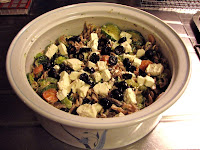
The symptoms of (peri)menopause are many. It's almost bizarre what happens to the body in the name of reverse puberty. Like indigestion. I have had a cast iron stomach my whole life - until now. Now I find myself experiencing GERD (gastroesophageal reflux disease) and heartburn. The really bad part is that it takes away the joy of eating, a joy I don't want to lose. Enter recipes for people with gastric reflux. I tried a few I found via heartburn.about.com . Pictured here are my versions of "Cashew Vegetable Fried Rice" (above) and "Bean and Cheese Burritos with Avocado" (below). Making the bean burrito dish required refried beans. Refried beans are not the sort of dish we ever made at home; we got it at Mexican restaurants. I've always liked them and, for a happy while here in Bergen, I found canned refried beans in the foreign food section at my local grocery store. But no more. So the question wasn't just how to make refried beans, but also ...

Happy New Year!

I hope you remember(ed) to count One Mississippi after 23:59:59 tonight before popping the champagne cork at midnight. Have a wonderful 2009!

The bilingual advantage

A researcher, Bente Ailin Svendsen, in linguistics at the university in Oslo has concluded that bilingualism is an advantage (Norw. article). It doesn't lead to confusion; it leads to greater flexibility. The article says about her findings (quoted text my translation): Bilinguals react faster to stimuli than do monolinguals, and the brain seems to stay in better shape. Studies from the US and Norway show that students with long-term bilingual education do best at school. Ah. I do react fast to stimuli, to the point that I've been wondering if I have ADHD. I did do well in school, too, but I was a smart kid before I learned Norwegian - which is probably why I learned enough Norwegian in three months to move up a class. I was supposed to be in third grade (today's fourth), but the Norwegian school started me in second so I could learn the language without being "bothered" by learning new stuff as well. By Christmas I was fully ready to move to my proper grade (...

Wordless Wednesday 2 - Super collider logo

Image
Wordless Wednesday I'm sure you've seen the Google logo for the super collider already. I'm reposting because in one way, it is historical.

Weight, the final frontier*

Comics are educational. Today's User Friendly comic got me curious, and I ended up learning something new about the kilogram - or rather, how one keeps a standard of weight so we know whether or not we have a kilo (as we "locals" say). I got curious about the reference to the roundest objects in the world, so I went a-googling and found that there is a reason besides "because we can" for creating the spheres: "The kilogram is the only remaining standard of measurement tied to a single physical object: a 120-year-old lump of platinum and iridium that sits in a vault outside of Paris, France. But the mass of this chunk of metal is slowly changing relative to the 40-odd copies kept by other countries, and no one knows why or by how much." So researchers charged with policing units and measures, called metrologists, have come up with several suggestions to redefine the kilogram. […] One proposal, pushed by an international team called the Avogadr...

Grass farming

I grew up in an era where there was a call of "back to nature" (the influence of the flower children of the 60's), where more and more humans stopped defining all the members of nature (from bacteria to whales) as having the quality of good or bad. We had embraced ecology and the awareness that our own value system has nothing to do with the natural order, and that the natural order is perfectly set up and not to be meddled with. So I ended up not hating the lion for killing the cute antelope, nor thinking the antelope was all that cute. Rather, they just are, and one can admire the grace and ability of each species to make the best of rather tricky and life-threatening situations without labeling. Ah, evolution... Also, when I was growing up, organic farming was getting (back) into fashion, and I never lost faith in it. Happily, I keep coming across all kinds of reasons for why working with nature as it is - rather than inventing and using chemicals and genetic modific...

The joy of small electronics

There is much to be tickled and awed by on the web and if you read sites like Neatorama or Boing Boing or even Cute Overload , you've already seen a lot of the stuff. Thanks to link curiosity via something else Neatorama posted, I came across this little video on machine mimicking nature. Robots Inspired by Animals - video powered by Metacafe Seeing robots instantly made me think of electronics (robotics being a combination of electronics, mechanics and programming) and got me thinking. In my first full-time job out of high school, I was introduced to computers, or more accurately: Data entry operating. It was a keyboard and a screen with green letters on black. I was terrified at using the thing but after learning how to correct mistakes during my first afternoon with it, I was in love. My second full-time job was as a secretary in the branch office of a mini-computer corporation (a mini-computer back then being the size of a washing machine). I was a whiz at programmin...

Where to, honey bee?

Image
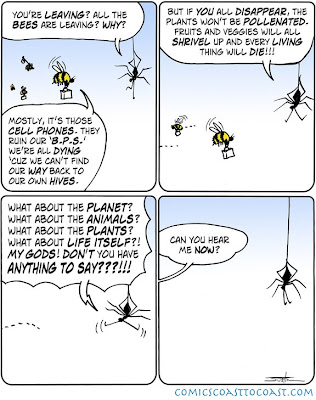
The US is facing a possible agricultural disaster. Honey bees are vital to fruit crops because they pollinate the flowers of fruits and vegetables. But in 2006, hives were suddenly being abandoned. The bees themselves disappeared without a trace, leaving no clues behind, and no other bees came to take over the hives. The phenomenon is called colony collapse disorder . The mystery repeated itself in 2007, and now almond growers in California are very worried about their 2008 crop, since almond trees rely solely on honey bees for pollination. Other countries are reporting similar colony collapses. The theories about why honey bees are suddenly disappearing are several: New pesticides, a more virulent virus and even disorientation from wireless networks and cell phones. This last is illustrated by the comic "Mythtickle" : The cell phone explanation seems to be based on a misunderstanding . I am relieved about that because I just got a wireless connection for my computer ...

P(h)unny physics

Image
I rediscovered an old favorite, User Friendly , and started poking around in the archives. I came across this: I got the joke/pun and laughed out loud, but then I started wondering what a brane actually was so I went a-lookin' (using define:"whatever" you need defined without the "" in Google's search box) and found this definition at good ol' PBS: brane: any of the extended objects that arise in string theory. A one-brane is a string, a two-brane is a membrane, a three-brane has three extended dimensions, etc. More generally, a p-brane has p spatial dimensions. P-brane. LOL! Geddit? Peabrain. Oh, those physicists! I wonder what a no-brane(r) is? *gigglesnort* Whadya mean, I must have one?

Cool (re)construction!

I'm in awe. This man shifts huge blocks of concrete weighing many tons - alone, without fancy tools or machines. He's reconstructing Stonehenge in his backyard. Get a fun physics lesson from Wally Wallington : (Via Boing Boing .) PS: Can somebody please explain the "two small rocks" method? I'm not clear on either where the pebbles are being placed, nor how it's helping him move the block. (Max?) UPDATE: Max came through for me! Check the comments! Thanks, Max!

Blood types here and there

A blood drive at work (I didn't participate at this time) offered some trivia about the distribution of blood types, which got me thinking. I gave blood a couple of times back when I lived in California, so I knew my blood type (O) was very common and very much in demand. I was therefore surprised to learn of the high number of type A's in Norway. While hunting for the US statistics, I learned that the majority of the A's in Norway live in the northern part of the country. So I looked up the statistics for the Sami people, who live primarily north of the arctic circle: People/per cent Type O Type A Type B Type AB USA (whites) 45 40 11 4 Norway (Norwegians) 39 49 8 4 Sami (Lapps) 29 63 4 4 The distribution for Danes, Swedes and Finns is pretty similar to the Norwegians. The Icelanders, however, show a very clear preference for type O. My own blood type seems to be influenced by my British Isle ancestry.

Stargazing by touch

On this planet we have deaf drummers and composers. Our planet may now be fostering blind astronomers. Via Phil Plait's Bad Astronomy Blog, I have learned of a woman who had a marvelous idea : Making astronomy books you can touch so the seeing impaired, too, can discover what's up in the sky. Head over to the BABlog to watch a clip of Noreen Grice explaining her brilliant idea, or watch it and read the press release at the Hubble site . It impressed me to hear how Grice solved a problem, and it touched me to hear what it inspired in her readers. With technology, not even the sky is the limit. For anyone.